Above the Line, Outside the Deed: Untangling a Flying Freehold Before Your Lender Does
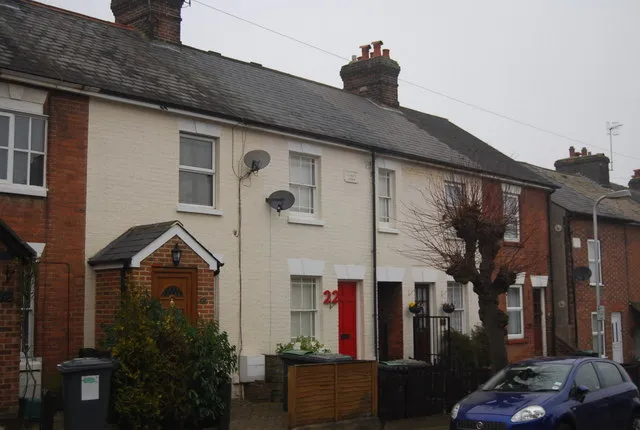
Photo: N Chadwick , CC BY-SA 2.0, via Wikimedia Commons
Most buyers approach a purchase assuming that ownership is a simple vertical matter: the whole house, the whole plot, one title. In older British towns, that assumption is frequently wrong. Where a building has grown organically — an archway driven through a terrace, a first-floor room bridging a neighbour's passage, a cellar running under the pavement — the legal boundaries stop following the walls. The result is a flying freehold, and it remains one of the more reliable ways to derail a mortgage in 2026.
What the term actually describes
A flying freehold exists where part of a freehold property physically overlaps, above or below, land or buildings held on a separate freehold title. The classic example is a room extending over a shared accessway belonging to the next-door owner. The reverse occurs where a cellar or basement extends beneath a neighbour's ground-floor accommodation.
Strictly, the label covers two situations: the flying freehold, where your space projects over someone else's land, and the flying (or hovering) freehold in its descending form, where your structure sits beneath theirs. Solicitors sometimes distinguish these as positive and negative flying freeholds. Lenders rarely bother with the distinction, treating both as a single category of structural interdependency.
Why it unsettles a mortgage application
A lender's concern is straightforward. If a portion of the security sits outside the borrower's legal ownership, enforcement becomes complicated. A possession claim on a property that physically depends on a neighbour's structure is not a clean process, and the resale market for such homes is narrower. Many high-street lenders will decline outright; others will consider the case only with additional reports and, occasionally, a higher interest rate or reduced loan-to-value.
Insurers apply similar logic. Standard buildings policies often include an exclusion for damage arising from the collapse or movement of a neighbouring structure not owned by the policyholder. That exclusion can leave the flying portion underinsured precisely when it matters.
Reading the title and title plan
The first opportunity to identify the issue is the title register and its accompanying plan. Ask specifically for the filed plan at a usable scale, not the small-scale overview. Look for boundaries that terminate abruptly mid-building, or for a title edged in red that excludes a visible part of the structure you are buying.
Three signals deserve attention:
- Hatched or excluded areas on the plan, particularly where they cross the footprint of the building itself.
- Rights reserved in the register — language granting a neighbour rights over part of your structure, or reserving rights to you over theirs.
- Easements and covenants referring to support, shelter or the maintenance of walls and roofs that are not wholly within your title.
Where the plan is ambiguous, request an index map search and, if the matter remains unclear, a plan drawn by a surveyor engaged specifically to establish the physical extent of ownership.
The questions worth putting in writing
The seller's solicitor is obliged to answer enquiries truthfully, and a written record is valuable. Requests that consistently produce useful answers include:
- Does any part of the property extend over or under land in third-party ownership? If so, please identify the affected areas on a plan.
- What rights of support and shelter exist, and in whose favour?
- Who is responsible for maintaining the overlapping structure, and is that obligation reciprocated?
- Has any deed of easement, reciprocal covenant or indemnity covenant been granted, and is it registered?
- Have insurers previously declined, restricted or repriced cover on this basis?
- Has any lender declined a mortgage on the property in the past, and on what grounds?
A candid seller will usually know. A seller who does not know is not necessarily concealing something, but the gap itself is a reason to instruct your own solicitor to investigate rather than rely on the conveyancing report alone.
Mitigation, and what it is worth
Where the exposure is limited, several routes exist. A deed of easement and mutual covenant between the freeholders can formalise support and maintenance obligations, which some lenders will accept. A specialist indemnity policy may satisfy others, though indemnities address financial loss rather than physical risk and are not a substitute for structural clarity.
In some cases the cleanest solution is for the two titles to be brought under single ownership, or for the overlapping portion to be demised under a lease. Both are slow and cost money — but they convert an awkward property into a mortgageable one, and that conversion is often worth more than the legal fees.
Pricing the risk before exchange
The practical question is not whether a flying freehold is bad, but how much the market discounts it. Comparable evidence is thin, so build the estimate from the cost side: the likely legal work to regularise the arrangement, the insurance premium differential, and the narrower pool of future buyers. Where a lender agrees to proceed only at a reduced loan-to-value, the deposit shortfall is itself a cost.
If the discount available is smaller than the cost of mitigation, the property is not necessarily a poor purchase — but you should go in with your eyes open and your solicitor instructed on the point. If it is larger, you have a negotiating position worth using.
The view from here
Flying freeholds are an old feature of British building stock, and they will not disappear. What has changed in 2026 is the rigour with which lenders and insurers interrogate them. A buyer who identifies the issue at offer stage, rather than at valuation, holds the advantage: there is time to instruct, to negotiate and, if necessary, to walk away without losing more than a survey fee.
Local knowledge matters here. In towns where terraces were extended piecemeal over decades, the pattern of ownership is rarely uniform, and an agent familiar with the street can often tell you which properties carry arrangements and which do not. That conversation, early, is worth more than a late legal scramble.