The Alley Behind the Wall: How Rear Access Quietly Reprices a Victorian Terrace
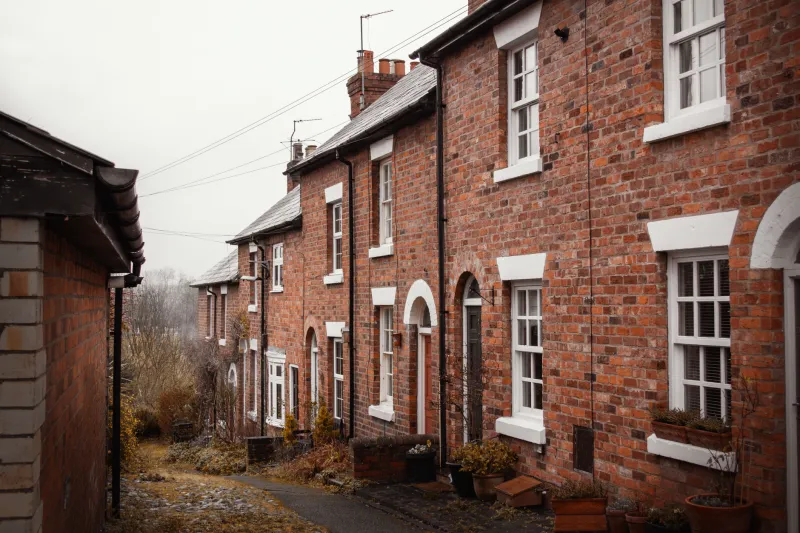
Walk along any street of Victorian terraces and you will notice that the houses are, broadly, identical. Same bay, same brick, same proportions. Yet one will sell in a fortnight and the next will sit for four months, and the difference is frequently invisible from the pavement. It is at the back: a strip of tarmac, a ginnel between two walls, a lane wide enough for a van. Rear access is the least photographed asset in British residential property and, in our experience, one of the most reliably mispriced.
The Feature That Never Reaches the Brochure
Selling agents describe what can be seen. A rear service lane cannot be photographed attractively, cannot be captioned in three words, and often cannot even be confirmed without a title search. So it is left out, and buyers compare two terraces on the basis of kitchens and bathroom tiles when the meaningful difference sits behind a gate they never opened.
This is not a small inefficiency. In towns where the Victorian grid was built with back lanes — much of Leeds, Sheffield, Cardiff, Bristol, the older suburbs of Manchester and the London terraces east of the City — the presence or absence of usable rear access shapes what the plot can become for the next thirty years.
What a Working Rear Boundary Actually Buys You
A service lane is not a decorative extra. It is infrastructure.
Buildability. An extension that must be carried through the house — skips, cement, steel, scaffolding — costs materially more than one served from the rear. Contractors price inconvenience, and they price it steeply. Where the only route to the garden is through a finished hallway, many trades will add a premium before they quote a single figure.
Permitted development room. Rear extensions, outbuildings, garden rooms and home offices all sit more comfortably on a plot with a second point of access. Planning authorities are more amenable, neighbours less exercised, and the practical build cleaner.
Parking and hardstanding. In streets where on-road parking is contested, a hardstanding reached across a rear lane can be worth as much as an additional bedroom in the right location. It requires a dropped kerb, a crossover consent from the highway authority and a lane of adequate width — but where all three align, the premium is real and durable.
The unglamorous essentials. Bin storage that does not colonise the front path. A cycle store that survives the winter. Somewhere to put a shed, a bench, a hedge that is not the boundary wall. None of this sells a house; all of it makes one pleasant to live in.
Reading the Title: Where Access Rights Actually Live
The critical distinction is between owning a lane and having the right to use one. Buyers routinely assume the first when only the second exists — and occasionally assume nothing when a valuable freehold is included.
Ask for the following before you exchange.
- The title register. Look for wording such as a right of way granted or reserved, or a coloured area on the filed plan denoting land within the title. Both should be read literally, including any restriction on vehicles, hours or maintenance contribution.
- The filed plan. Shading, edging and numbering matter. A hatched strip can indicate a right of access over someone else's land rather than ownership.
- Whether the lane is adopted. Most back lanes are not maintained by the highway authority. Confirm who repairs the surface, who clears the drains and, where the lane serves several properties, what proportion of the cost falls to your seller.
- Covenants. Restrictive covenants occasionally prohibit commercial use, parking, or outbuildings at the rear. A covenant that forbids the very thing you intend to build changes the arithmetic entirely.
- Unregistered or ambiguous boundaries. Where the title is silent and the lane has been used openly for decades, evidence may need to be assembled rather than simply read.
This is conveyancing territory, and it is not a place for assumptions formed during a fifteen-minute viewing. Instruct a solicitor to confirm the position in writing before you commit.
The Site Inspection That Settles It
Paperwork describes rights; the site describes reality. Visit the rear boundary yourself and measure it.
Take a tape. Establish the narrowest point of the lane and the width of the gate. A standard skip lorry needs considerably more than a domestic alley offers, which is why many rear-access properties still require a licence and a permit-controlled skip on the street. Check the surfacing and the gradient — a steep, unmade lane becomes unusable to wheeled equipment in winter. Look for drainage gullies, standing water and the condition of boundary walls, since repairing a shared wall is a shared cost.
Then knock on doors. Neighbours will tell you within two minutes whether the lane is used, whether anyone treats it as private, whether a gate is habitually locked, and whether the local authority has ever been involved. That conversation is often more informative than the title.
Pricing the Difference
There is no published multiplier. What exists is a judgement, and it should be made explicitly rather than absorbed into a vague overall impression.
A workable method is to price the alternatives. What would a parking space cost nearby? What would a storage unit cost over ten years? What premium do local agents attach to a comparable terrace that has already been extended? Set those figures against the difference in asking price and you have an argument rather than an instinct.
At resale, rear access widens the buyer pool. It appeals to families with bicycles and pushchairs, to tradespeople, to anyone who has previously lived with a wheelie bin in a hallway. That liquidity has a value even in a soft market, and it is worth paying something for — though not, in our view, an unlimited amount. The lane is an advantage. It is not the house.
Buyers who ask the question early, and ask it of the title rather than the brochure, tend to be the ones who avoid discovering the answer at the point they apply for planning permission.